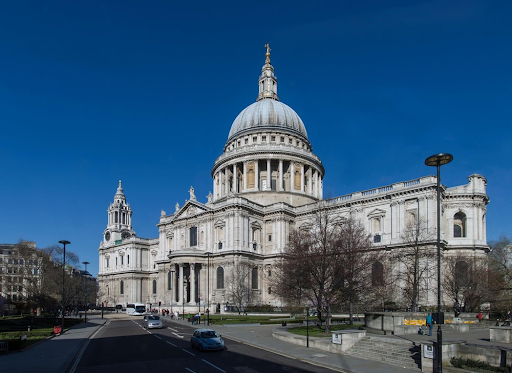


If you seek his monument, look around you.
Dear all
It was nice to welcome our students back on Monday from their half-term break.
It’s been Theology and Philosophy Enrichment week in school. In Monday’s assembly, we celebrated the recent birthday – on 20th or 30th October, depending on which calendar is used – of Sir Christopher Wren, architect of over 50 churches as London was rebuilt after its Great Fire in 1666, and of course, his most famous work – St Paul’s Cathedral. Indeed, when we imagine the London skyline, one of the first things we probably see in our mind’s eye is the dome of St Paul’s Cathedral.
The history of the site on which it stands actually dates back to the year 604 AD, when the first church was built there by King Ethelbert for Mellitus, the first Bishop of London. That was the first of three churches on this spot to be destroyed by fire, while the second was later destroyed by Vikings before the third was built in the year 962. The fourth, which historians call ‘Old St Paul’s,’ was begun by the Normans in 1087 and took over 200 years to finish. Its towering spire was 38 metres taller than the highest point of the current cathedral, but it was destroyed in September 1666 during the Great Fire of London. The flames were so intense that witnesses reported the building’s stones flying like grenades, and the cathedral’s lead roof melted, flowing like a stream of lava through the surrounding streets.
Out of the ashes, Sir Christopher Wren was commissioned to design a modern replacement. It took 35 years to construct and was officially declared complete on Christmas Day in 1711. When he died in 1723, Wren became the first person to be buried in the huge crypt. Above his tomb are the words: ‘Reader, if you seek his monument, look around you.’
Building on my last blog – the ‘entanglogram’ of London – I encouraged the students on Monday to add St Paul’s Cathedral to their list of places to see if they haven’t been there before. As well as features such as the Whispering Gallery, where a word murmured against the wall can be heard 30 metres away, it has also been there through some of the most momentous periods of our history, from unsuccessful suffragette bomb plots to the miraculous way in which it survived the Blitz in World War Two, offering a symbol of hope at a bleak time.
Have a great weekend
Best wishes
Michael Bond